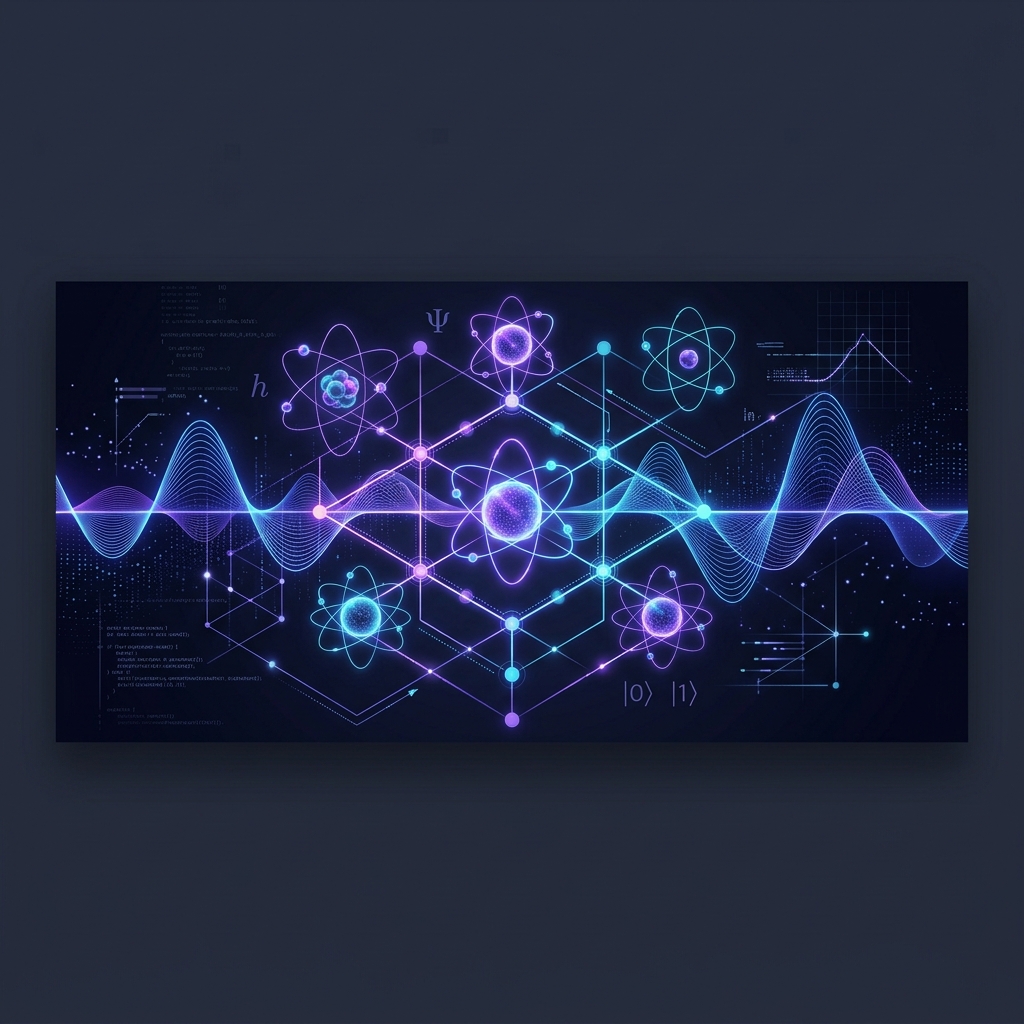
Deep Tech in Quantum Computing
Q-Layer & Physics
Harness the fabric of reality to solve the impossible.
A 3-year immersive degree merging Physics, Mathematics, and Computer Science.
Graduate prepared to program on quantum hardware and design algorithms that explore multiple paths simultaneously.
Available Degrees
B.Sc in Quantum Computing
Partner Institutions
Keshava Degree College
Industry Credentials
Program Length
3-Year Full-Time
Delivery Mode
On-Campus, Immersive
Campus Location
Hyderabad, India
Cohort Status
Admissions Closed
Program Overview
A Deep Tech Leap
Beyond Classical.
Study the core physics, linear algebra, and complex numbers required to write algorithms for superconducting QPUs. Explore superposition and entanglement to solve intractable problems in cryptography, sensing, and chemistry.
Full-time immersive program
Progressive skill building
QPU access and execution
Physics and logic combined
The Program Mix
Academic Sessions (40%)
Structured lectures covering Hilbert spaces, quantum algorithms and hardware physics.
Quantum Sim Lab (25%)
Programming quantum systems via Qiskit and simulating physical spin dynamics in QuTiP.
Hardware Access (15%)
Running algorithm passes directly on IBM Quantum superconducting QPUs and IonQ trapped ion processors.
Beyond Classical (10%)
Group research initiatives benchmarked against state-of-the-art literature.
Student Circles (10%)
Collaborative research and study groups focusing on physics, mathematics and engineering.
Built for the next generation
Who Is This For
Future Quantum Builders
Class 12 / Intermediate graduates from MPC or similar streams ready to explore physical computing logic.
Physics & Math Enthusiasts
Students fascinated by linear algebra, quantum states, and complex numbers.
Zero Coding Background
We start from the absolute mathematical grounds before deploying circuits.
Academic Criteria
Academic Eligibility
01Standard Admission Pathway
- Grade 12 / Intermediate from any recognized board.
- MPC or equivalent stream is preferred.
- Minimum 60% aggregate in mathematics and physics subjects.
Academic Map
What You Will Study
From physics postulates to programming transmon hardware. Every year builds on the last.
Program Roadmap
Core Stack
Industrial Skills


What You'll Become
From mathematical foundations to architecting global cognitive systems. This is your career in 2035.
Quantum Software Engineer
Develops and runs hybrid quantum algorithms (VQE, QAOA) using Qiskit and Cirq. Optimizes circuits for execution on near-term hardware.
Core Responsibilities
Quantum Software Engineer
Develops and runs hybrid quantum algorithms (VQE, QAOA) using Qiskit and Cirq. Optimizes circuits for execution on near-term hardware.
Core Responsibilities
Why is The Foundry the right place?
Physics First
You cannot hack reality without understanding it. We start with Linear Algebra and Quantum Mechanics before writing a single line of code.
Hardware Aware
Learn to program on Superconducting Qubits (IBM) and Ion Traps (IonQ). Understand noise, decoherence, and error correction.
Hybrid Algorithms
The near future is hybrid. Master VQE and QAOA to solve real-world optimization problems using both CPU and QPU.
Quantum Crypto
Build secure networks using Quantum Key Distribution (QKD) and defend against quantum-era decryption.